
Introduction
One of the questions many tradesmen ask when starting out in business is whether they should operate as a sole trader or a limited company.
Both structures are common in the UK construction and trades industry, and each has its own advantages and disadvantages.
Most people start as sole traders because it is simpler and easier to manage. However, as income grows, some tradespeople consider switching to a limited company for tax or business reasons.
Understanding the differences between these two options can help you choose the structure that suits your situation and keeps you compliant with the rules set by HM Revenue & Customs.
If you’re new to self-employment, it’s worth first understanding How Much Tax Should You Set Aside as a Sole Trader? as this often influences your decision early on.
Before we continue, download the free Tradesman Financial Toolkit. It includes a Tax Set-Aside Calculator, Cash Flow Planner, Day Rate Calculator and more.
The Question Almost Every Successful Tradesman Eventually Asks
Most self-employed tradesmen start as sole traders.
Read: How Self-Employed Tax Works for Tradesmen (Complete Guide)
It’s simple, cheap and gets you up and running quickly.
But as the business grows, many eventually start asking:
“Should I become a Limited Company?”
Usually, that question appears when:
- The profits start increasing.
- The tax bills become bigger.
- The business begins to feel more serious.
The problem is that there isn’t one answer that suits everyone.
The right structure depends on:
- Your profits.
- Your future plans.
- How much administration you’re prepared to deal with.
What Is a Sole Trader?
A sole trader is the simplest way to run a business.
In this structure, the individual and the business are legally the same entity. This means the business income is treated as personal income.
Most self-employed tradespeople in the UK operate as sole traders.
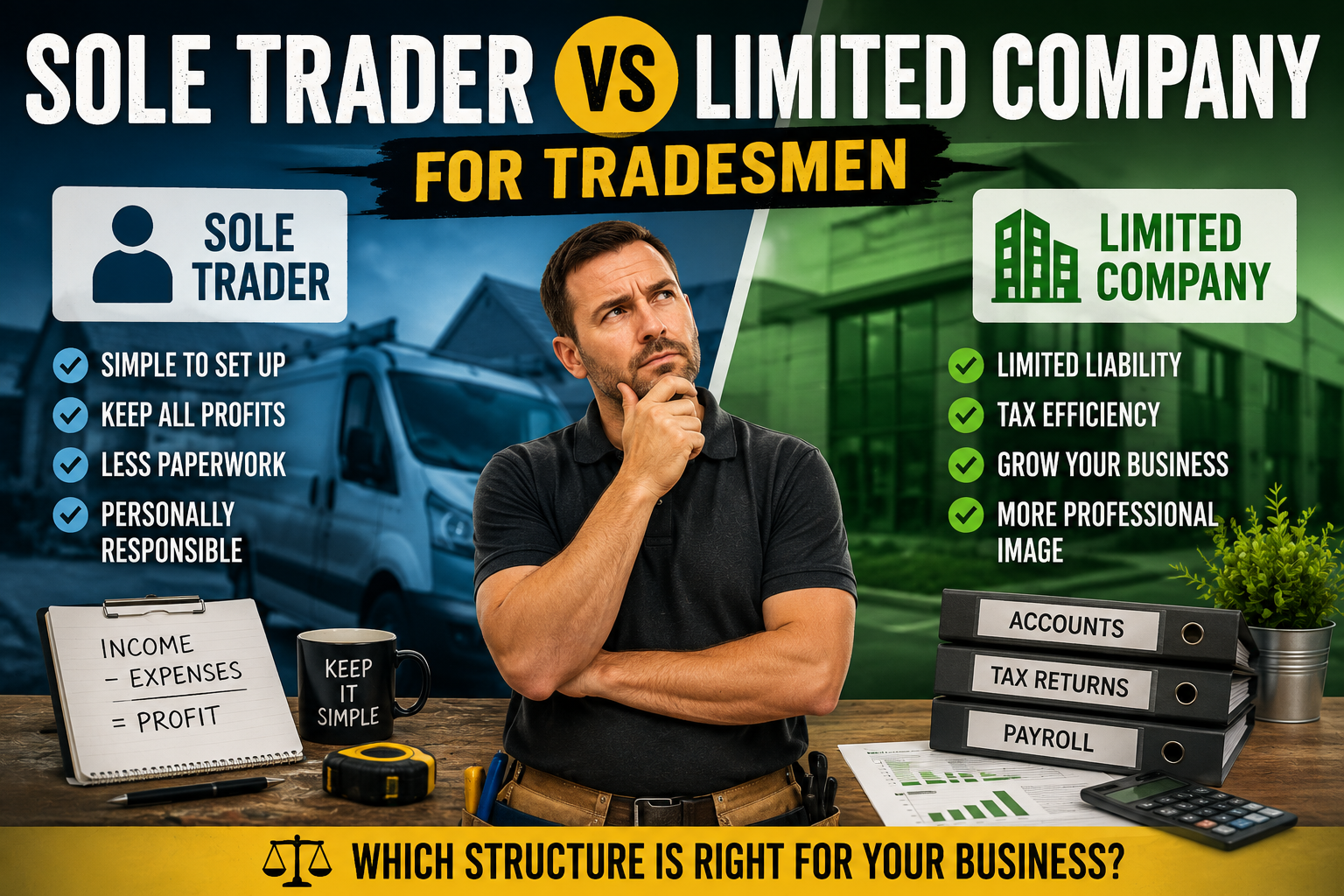
Key features of a sole trader business
- Easy to set up
- Minimal paperwork
- You keep all the profits
- You are personally responsible for the business
To operate as a sole trader, you must register for Self Assessment with HM Revenue & Customs and submit a tax return each year.
Tax is then paid on your profit, after business expenses have been deducted.
Many new tradesmen underestimate their tax bill in the early years — see The Most Common Tax Mistakes Self-Employed Tradesmen Make
What Is a Limited Company?
A limited company is a separate legal entity from the person running it.
This means the company exists independently and can enter contracts, earn money, and pay tax in its own name.
Limited companies in the UK are registered with Companies House.
As the owner, you normally act as a director of the company and may pay yourself through a combination of salary and dividends.
Key Differences Between Sole Trader and Limited Company
Legal Responsibility
A sole trader is personally responsible for all business debts.
With a limited company, the company itself is responsible for its debts. In many situations this provides limited liability protection for the owner.
Tax Structure
Sole traders pay:
- Income Tax
- National Insurance
Limited companies pay:
- Corporation Tax on company profits
- Personal tax on any salary or dividends
Tax efficiency can vary depending on income levels, which is why understanding your real profit is important — not just turnover. See Why Being Busy Doesn’t Mean You’re Making Money
Does Going Limited Always Save Tax?
No.
This is one of the biggest misconceptions among self-employed tradesmen.
Some people assume:
Limited company = lower tax.
But that’s not always true.
For some businesses, the tax savings can be relatively small once you consider:
- Accountancy costs
- Additional administration
- Payroll requirements
- Company filings
The decision should never be based purely on tax.
It should also consider:
- Simplicity
- Growth plans
- Liability protection
- Future goals.
Read: How Much Tax Should a Self-Employed Tradesman Set Aside in the UK?
Administration and Paperwork
Sole traders generally have less paperwork.
Typical requirements include:
- Keeping records of income and expenses
- Submitting a Self Assessment tax return
Limited companies usually involve more administration, including:
- Company accounts
- Corporation tax returns
- Annual filings with Companies House
Because of this, many limited company owners use an accountant.
Poor record keeping causes problems regardless of structure — covered in The Most Common Tax Mistakes Self-Employed Tradesmen Make
Professional Image
Some tradesmen feel that operating as a limited company can make their business appear more established or professional.
Certain larger contracts or commercial clients may prefer working with limited companies.
However, many successful trades businesses still operate perfectly well as sole traders.
Some Customers Don’t Care
Many tradesmen worry that they don’t look professional unless they have “Ltd” after their name.
In reality, most domestic customers care far more about:
- Good reviews
- Reliability
- Communication
- Quality of work
Being a limited company doesn’t automatically make you a better business.
Many highly successful trades businesses operate perfectly well as sole traders.
When Tradesmen Start Considering a Limited Company
Many tradespeople begin as sole traders and only consider forming a limited company when:
- Profits increase significantly
- They start employing staff
- They want to grow the business
- They want additional liability protection
The right decision often depends on the size and future plans of the business.
For example, a self-employed electrician earning £35,000 per year may find the sole trader structure simple and cost-effective.
However, if profits increase to £80,000 or more, some tradespeople begin considering a limited company structure to improve tax efficiency.
At this point, understanding how your income is structured — and how much tax you actually pay — becomes critical. See Payments on Account Explained for Tradesmen
Signs It Might Be Time to Speak to an Accountant
You might want professional advice if:
- Your profits are increasing significantly.
- You’re regularly paying higher-rate tax.
- You’re employing staff.
- You’re planning to grow the business.
- You’re thinking about buying property through the company.
- You’re unsure how to pay yourself efficiently.
An accountant won’t make the decision for you.
But they can help you understand the numbers.
Read: Xero vs QuickBooks for Tradesmen (UK) Which One Should You Choose
Getting Professional Advice
Choosing between a sole trader structure and a limited company can affect both tax and legal responsibilities.
Because every situation is different, many tradesmen choose to discuss their options with an accountant or financial advisor before making the change.
This helps ensure the business structure works in the most efficient way possible while staying compliant with HM Revenue & Customs.
Sole Trader vs Limited Company: Quick Guide
| Situation | Usually Better Option |
|---|---|
| Just starting out | Sole Trader |
| Lower profits | Sole Trader |
| Want simplicity | Sole Trader |
| Growing profits | Often Limited Company |
| Employing staff | Often Limited Company |
| Asset protection concerns | Often Limited Company |
| Planning significant growth | Often Limited Company |
Frequently Asked Questions
Is it better to be a sole trader or a limited company?
Neither is automatically better. It depends on your profits, goals and circumstances.
At what income should I become a limited company?
There isn’t one magic number. Many tradesmen start reviewing their options as profits increase, particularly when they move into higher tax bands.
Can I change from a sole trader to a limited company later?
Yes. In fact, many tradesmen start as sole traders and switch later as the business grows.
Does a limited company pay less tax?
Sometimes, but not always. The overall picture depends on your income and how you take money from the business.
Do I need an accountant if I have a limited company?
Most limited companies use an accountant because the administration is more complex.
Final Thoughts
For many tradesmen, starting as a sole trader is the simplest and most practical option. It allows you to begin working, earn income, and manage your taxes with minimal complexity.
As a business grows, forming a limited company may become worth considering, particularly if profits increase or the business expands.
Understanding the differences between these structures helps ensure you choose the option that best suits your business goals.
Read: The Complete Tradesman Money Guide
Quick Comparison
| Feature | Sole Trader | Limited Company |
| Setup | Simple | More complex |
| Tax | Income Tax + NI | Corporation Tax + dividends |
| Liability | Personal liability | Limited liability |
| Paperwork | Minimal | More administration |
| Image | Standard | Often seen as more professional |
Key Points
- Sole traders are simpler and easier to manage
- Limited companies offer liability protection
- Limited companies involve more paperwork
- Many tradesmen start as sole traders and switch later
Leave a Reply