
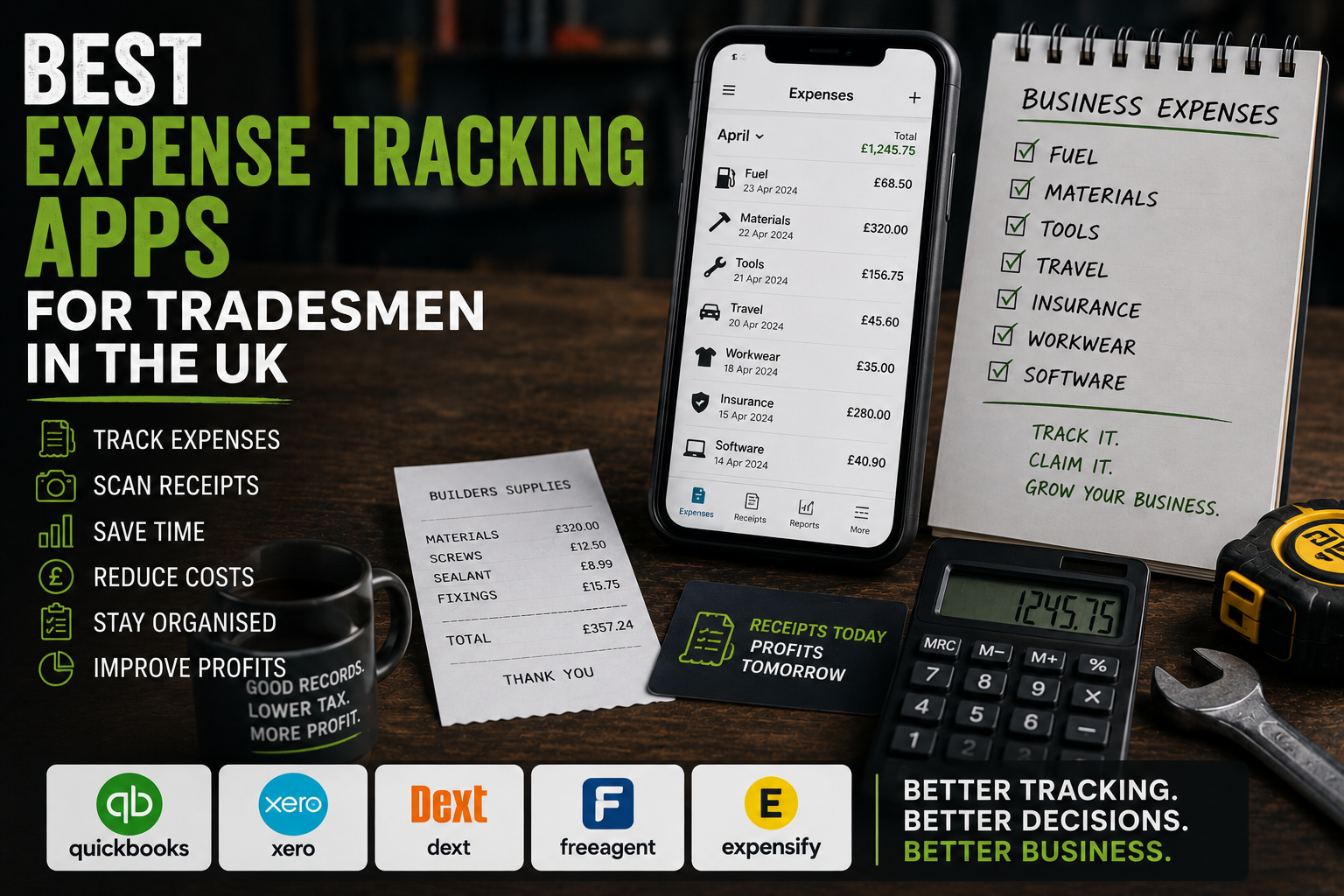
Most tradesmen don’t have a spending problem.
They have a tracking problem.
Fuel gets paid for on one card. Materials go on another. Tool purchases get buried in emails. Receipts end up stuffed in the van or forgotten altogether.
Then tax season arrives and suddenly you’re trying to remember what happened six months ago.
That’s where expense tracking apps can make a huge difference.
A good expense tracking app helps you:
- Record expenses quickly
- Store receipts digitally
- Keep bookkeeping organised
- Save time at tax return season
- Improve visibility over business spending
And perhaps most importantly, it helps you understand where your money is actually going.
Quick Comparison
| App | Best For | Receipt Scanning | Bank Feeds | Best Feature |
| QuickBooks | Most tradesmen | Yes | Yes | All-round solution |
| Xero | Growing businesses | Yes | Yes | Detailed reporting |
| Dext | Receipt management | Yes | No | Fast receipt capture |
| FreeAgent | Simplicity | Yes | Yes | Easy to use |
| Expensify | Teams | Yes | Yes | Employee expense control |
As discussed in How to Track Expenses Properly, many tradesmen lose track of hundreds or even thousands of pounds every year simply because they don’t have a proper system.
Why Expense Tracking Matters
Most trades businesses operate on relatively tight margins.
The problem is that many tradesmen know exactly what they earned last month but have no idea what they spent.
That’s why profit often feels lower than expected.
You might be earning good money, but if you don’t understand your expenses, it’s difficult to understand your true profit.
That’s why many tradesmen are surprised when they discover how much they spend each year on:
- Fuel
- Tools
- Van costs
- Insurance
- Workwear
- Software subscriptions
Understanding which costs are legitimate business expenses is equally important. If you’re unsure what can actually be claimed, see What Expenses Can Tradesmen Claim Against Tax.
Understanding these costs is a key part of managing profitability, something explored further in The Real Difference Between Turnover, Profit and Cash Flow.
What Makes a Good Expense Tracking App?
The best apps should:
- Allow receipt scanning
- Connect to your bank account
- Categorise expenses automatically
- Work from your mobile phone
- Export reports easily
- Integrate with accounting software
The goal isn’t complicated bookkeeping.
The goal is spending less time doing admin.
As covered in The Hidden Cost of Bad Time Management in the Trades, poor systems often cost more than people realise.
1. QuickBooks
QuickBooks remains one of the strongest all-round options for tradesmen.
Best for:
- Sole traders
- Small limited companies
- Growing trade businesses
Pros:
- Automatic bank feeds
- Receipt capture
- Expense categorisation
- Strong reporting
- Tax-ready records
Cons:
- Monthly subscription
- More features than some users need
If you’re already considering accounting software, read Best Accounting Software for Tradesmen and Xero vs QuickBooks for Tradesmen (UK): Which One Should You Choose?
2. Xero
Xero is widely used by accountants and business owners across the UK.
Best for:
- Established businesses
- Tradesmen wanting detailed reporting
Pros:
- Excellent expense tracking
- Bank reconciliation
- Receipt scanning
- Accountant-friendly
Cons:
- Slight learning curve
- Higher cost than simpler apps
Xero works particularly well once a business starts growing and expense management becomes more complex.
3. Dext
Dext focuses heavily on receipt capture and expense management.
Best for:
- Tradesmen drowning in receipts
Pros:
- Fast receipt scanning
- Automatic data extraction
- Integrates with Xero and QuickBooks
- Reduces paperwork
Cons:
- Additional monthly cost
- Less useful without accounting software
If your van currently contains a collection of faded fuel receipts, crumpled material invoices and random tool receipts, Dext could save you a significant amount of admin time. This becomes particularly useful when preparing tax returns or working through the records discussed in How Tradesmen Should Keep Financial Records.
4. FreeAgent
FreeAgent offers a straightforward approach to expense tracking.
Best for:
- Sole traders
- Smaller businesses
Pros:
- Easy to use
- Good mobile app
- Expense tracking included
- Tax estimates
Cons:
- Fewer advanced features
This can be a good option for tradesmen who want simplicity rather than endless reports and dashboards.
5. Expensify
Expensify is one of the most recognised expense management apps globally.
Best for:
- Businesses with employees
- Multiple expense submitters
Pros:
- Receipt scanning
- Expense approval workflows
- Mileage tracking
Cons:
- More business-focused than trade-focused
For larger operations, it provides much greater control over employee spending.
The Hidden Cost of Poor Expense Tracking
Poor expense tracking creates more problems than most tradesmen realise.
It can lead to:
- Overpaying tax
- Missing allowable expenses
- Incorrect job pricing
- Poor cash flow decisions
- Unexpected financial surprises
Many of the tradesmen who feel permanently short of money aren’t earning too little.
They’re simply operating without accurate financial information.
Common Expense Tracking Mistakes
Keeping Receipts in the Van
Every tradesman has done it.
The problem is receipts fade, get lost, or disappear altogether.
Digital storage is far safer.
Mixing Business and Personal Spending
This creates bookkeeping headaches.
It’s one of the reasons I always recommend separating finances early. See How to Separate Personal and Business Money for a simple system.
Waiting Until Year-End
Trying to organise an entire year’s expenses in January is a miserable experience.
As explained in How to Avoid the January Tax Panic, small weekly habits are far easier than last-minute catch-up work.
Do Tradesmen Really Need an Expense Tracking App?
Strictly speaking, no.
A spreadsheet can work.
But the question isn’t whether it’s possible.
The question is whether it’s efficient.
Most tradesmen would rather spend their evenings:
- With family
- Quoting jobs
- Relaxing
Rather than sorting receipts.
Good systems remove unnecessary admin.
How Expense Tracking Improves Cash Flow
Many tradesmen focus entirely on sales.
More work doesn’t always mean more profit.
If costs rise at the same speed as turnover, the business may feel busier without becoming financially stronger.
But improving profit often comes from controlling expenses.
When you understand exactly where money is going, it’s easier to:
- Cut unnecessary costs
- Price jobs properly
- Improve profit margins
This links directly to What Are Overheads for a Tradesman? (Full Breakdown UK) and The Real Cost of Running a Trades Business in the UK.
The better you understand your costs, the easier it becomes to charge correctly. That’s one reason so many tradesmen unknowingly undercharge, a topic covered in Why Most Tradesmen Undercharge for Jobs.
Frequently Asked Questions
What is the best expense tracking app for tradesmen?
For most tradesmen, QuickBooks and Xero provide the strongest overall combination of expense tracking and accounting.
Can expense tracking apps help with tax returns?
Yes. They make it easier to record expenses, store receipts and provide evidence for allowable business costs.
Are expense tracking apps worth paying for?
Usually yes. The time saved and improved organisation often outweigh the monthly subscription cost.
Can I track expenses without accounting software?
Yes. Apps such as Dext and Expensify can work alongside spreadsheets, although integration with accounting software is usually more efficient.
My Recommendation
For most UK tradesmen:
- Best overall → QuickBooks
- Best reporting → Xero
- Best receipt capture → Dext
- Best simplicity → FreeAgent
- Best for teams → Expensify
The best app isn’t necessarily the cheapest.
It’s the one you’ll actually use consistently.
Because in the trades, strong financial systems often make a bigger difference than working longer hours.
If you want to improve the financial side of your business further, also read:
- How to Track Expenses Properly
- Best Accounting Software for Tradesmen
- Best Invoicing Apps for Tradesmen in the UK
- Best Fuel Cards UK
- How Tradesmen Should Keep Financial Records
The businesses with the strongest profits are rarely the businesses with the most paperwork. They’re the businesses with the best systems. Good expense tracking gives you better information, better decisions and ultimately better financial results.
Leave a Reply