
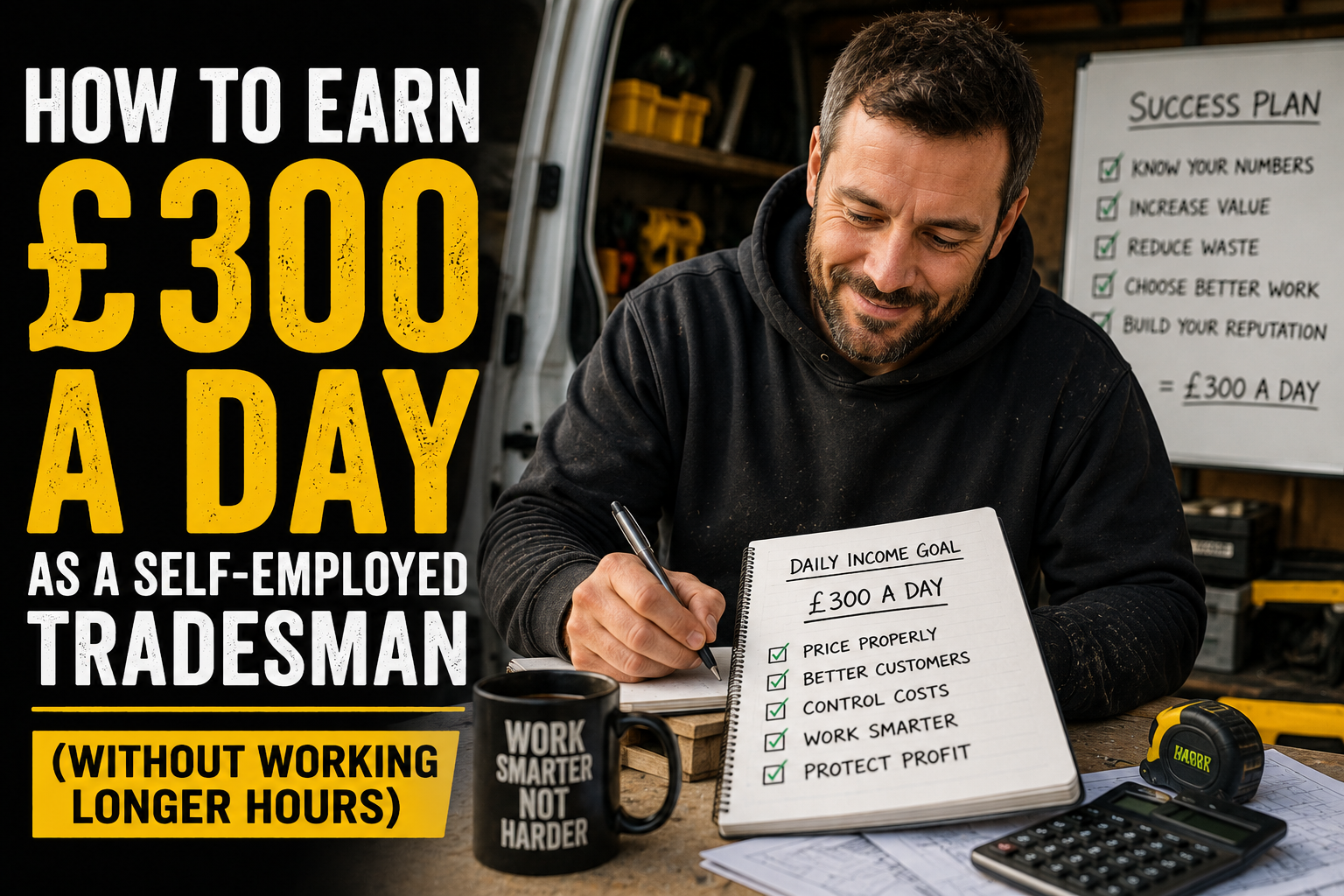
Think £300 a Day Is Impossible?
Every tradesman knows someone who claims to earn £300 a day.
Some genuinely do.
Others exaggerate.
But whether the figure is £250, £300 or £400, the real question isn’t whether it’s possible.
It’s how you get there.
After reading The Truth About £300 a Day, many tradesmen ask the same question:
“That’s all well and good, but how do I actually get there?”
The good news is that earning £300 a day isn’t reserved for the biggest companies or the most experienced tradesmen.
In many cases, it’s about running your business better rather than working harder.
The biggest mistake is assuming you simply need to put your prices up overnight.
The reality is very different.
First, Know Whether £300 a Day Is Actually Your Goal
Before trying to reach £300 per day, ask yourself one question.
Do you actually need to earn £300 per day?
Depending on your household expenses, business overheads and financial goals, you might need more—or you might need less.
Successful tradesmen don’t copy someone else’s income target.
They calculate their own.
surprisingly, some tradesmen discover they only need £240–£260 per day to achieve the lifestyle they want, while others realise even £300 won’t cover their costs.
The number only matters once you know what you’re aiming for.
Read How Much Is Enough? The Income Every Tradesman Should Aim For
and What Is a Good Income for a Tradesman in the UK?
Stop Charging for Time—Start Charging for Value
One of the biggest reasons tradesmen never reach £300 a day is because they’re pricing themselves based on what competitors charge.
Instead, ask:
- How much value am I providing?
- How much does this save the customer?
- How much expertise am I bringing?
Customers rarely choose the cheapest tradesman.
They choose the one they trust most.
Customers don’t remember your hourly rate.
They remember whether you solved their problem professionally.
This article will help How to Price a Job Properly (Step-by-Step)
and Why Most Tradesmen Undercharge for Jobs
Increase Your Day Rate Gradually
Jumping from £200 to £300 overnight may lose you work.
Increasing your rates by £20–£30 every few months while improving your service is much more sustainable.
Many tradesmen are surprised how little resistance they get when they become more professional.
That extra £25 per day soon adds up.
An extra £25 per day over 220 working days is an additional £5,500 of annual revenue before you even win another customer.
That’s often easier to achieve than finding enough extra work to earn another £5,500 every year.
look over How to Increase Your Day Rate Without Losing Work
and use our Free Tradesman Day Rate Calculator
Choose Better Customers
Not every customer is worth working for.
Some constantly negotiate.
Some delay payment.
Others expect extra work for free.
The tradesmen consistently earning £300+ per day usually spend less time chasing difficult customers and more time working for people who value quality.
Sometimes saying no to one poor customer creates room for a much better one.
Some useful links –
How to Spot a Bad Customer Before You Start a Job
Should You Take On Every Job And When To Say No
How to Know If a Job Is Worth Taking Before You Start
Stop Losing Profit on Jobs
Earning £300 per day isn’t just about charging more.
It’s also about keeping more of what you earn.
Many profitable-looking jobs become poor jobs because of:
- Scope creep
- Underestimating labour
- Material price increases
- Extra visits
- Fuel costs
Every pound you stop losing is a pound you don’t have to earn again.
Increasing your prices by 10% helps.
Stopping 10% of your profit leaking away can have exactly the same effect.
You my find the the below articles useful –
How to Manage Scope Creep on Jobs
Why Tradesmen Lose Money on Jobs in the UK
Free Tradesman Job Profit Checker
Got a Problem That’s Stopping You Making £300 a Day?
The advice above works in general. But your situation might be different.
Maybe you’re working six days a week but still don’t have enough money left. Maybe you’ve got plenty of work but your bank balance keeps falling. Or perhaps one job has gone badly wrong and you’re not sure what to do next.
Tell us what’s happening.
We’re testing a new service where we’ll look at a real tradesman’s problem and give practical advice on what we think you should do next.
The first 10 problems are free while we’re testing it.
We’ll ask for your email address so we can send you our response.
Know Your Break-Even Point
If you don’t know exactly what your business costs every day to operate, you’ll never know whether you’re actually making money.
Knowing your break-even point allows you to:
- Price confidently.
- Walk away from poor jobs.
- Understand your minimum daily income.
It’s one of the most powerful numbers in any trades business.
Once you know your break-even point, every quote becomes a business decision rather than a guess.
These articles will help –
How to Work Out Your Break-Even Point as a Tradesman
Tradesmen Break-Even Calculator
Reduce Costs Before Chasing More Work
Sometimes the quickest way to earn more isn’t by finding another customer.
It’s by spending less.
Review your:
- Van costs
- Fuel
- Materials
- Software subscriptions
- Buying habits
Saving £20–£30 per day has exactly the same effect on profit as earning an extra £20–£30.
Try reading these articles –
How Better Buying Can Add Thousands to a Tradesman’s Profit
How Much Does It Cost to Run a Van in the UK Per Year
How Tradesmen Should Handle Rising Fuel Costs (Without Losing Profit)
Become Easier to Recommend
The tradesmen earning the highest day rates usually have one thing in common.
They don’t spend every evening looking for work.
They’ve built a reputation that brings work to them.
Simple improvements can justify higher prices:
- Turn up when promised.
- Communicate clearly.
- Send professional quotes.
- Keep customers informed.
- Leave the site tidy.
- Ask for reviews.
Customers happily pay more when they trust the person doing the work.
Specialise Instead of Generalising
The highest earning tradesmen aren’t always the hardest working.
They’re often the most specialised.
Instead of trying to do everything, they become known for something.
For example:
Consumer units.
EV chargers.
Heat pumps.
Luxury bathrooms.
Commercial maintenance.
Specialists usually command higher prices because customers see them as experts rather than general tradesmen.
If increasing your income is the goal, becoming known for solving a particular problem can often be more effective than simply working longer hours.
Internal Link: 4.10 What Qualifications Do Tradesmen Actually Need to Win Better Work
Work Smarter, Not Longer
Working twelve-hour days isn’t the answer.
Neither is working every Saturday.
The goal is to increase the value of every working day.
Sometimes one better-priced job is worth more than two poorly priced ones.
The best tradesmen don’t always work harder.
They make better business decisions.
They understand that every hour saved through better planning can be used on profitable work rather than unpaid admin or travelling between jobs.
Why Tradesmen End Up Working 60 Hours a Week for Less Than Minimum Wage
Why Being Busy Doesn’t Mean You’re Making Money
£300 a Day Is a Business Goal—Not Just a Day Rate
The most successful tradesmen don’t think:
“I want to charge £300 a day.”
They think:
“I want my business to consistently generate at least £300 of profitable income every working day.”
That’s a very different mindset.
It means:
- Pricing correctly.
- Controlling costs.
- Choosing better customers.
- Protecting profit.
- Understanding your numbers.
Once you put those pieces together, £300 a day becomes far more achievable than most people realise.
Conclusion
There’s no secret formula for earning £300 a day.
It’s rarely about working longer hours or taking on more jobs.
Instead, it’s about building a business that works efficiently, prices confidently and keeps more of the money it earns.
If you can improve your pricing, reduce wasted costs and focus on profitable work, you’ll often reach £300 a day much sooner than you expected.
And once you do, don’t stop there.
The real goal isn’t simply earning more.
Related: Why Good Tradesmen Stay Broke While Average Ones Build Wealth
Remember, £300 a day isn’t a finish line.
It’s simply one milestone on the journey towards building a stronger, more profitable business.
Focus on improving one area at a time—pricing, customers, buying, productivity and profit—and the higher income often follows naturally.
It’s building a business that gives you financial security, more freedom and a better quality of life.
Whether your target is £250, £300 or £400 a day, the principles remain the same.
Understand your numbers, price your work properly, choose the right customers and protect your profit.
Do those consistently, and you’ll give yourself the best possible chance of building a successful and financially rewarding trades business.
Leave a Reply